2 Gbps: New Speed Record Set For Data Transmission Using LED Light
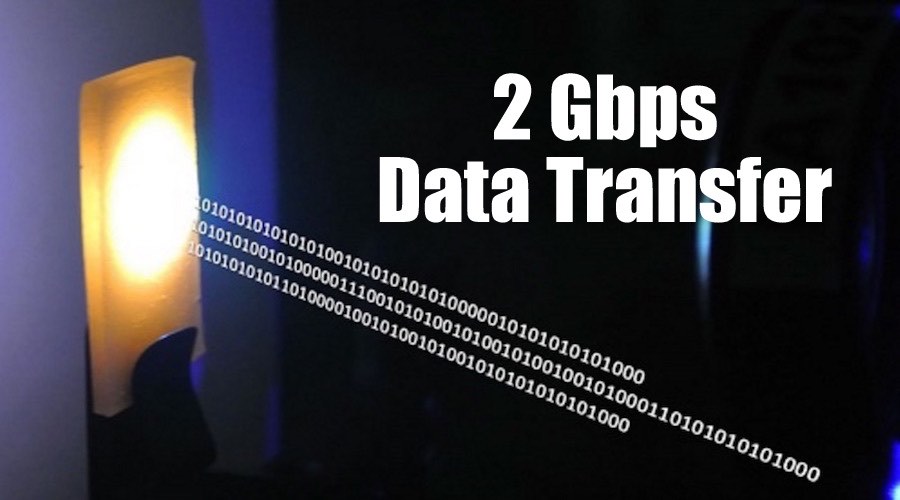
Short Bytes: A team of researchers has devised a new method to produce white light that supports data transmission rates up to 2 billion bits per second (2 Gbps). This light could be used to made efficient lighting systems and transmit information at the same time. The researchers expect that the white light LED bulbs will be replaced by the bulbs that generate white light using semiconductor lasers.
A similar research in the King Abdullah University of Science and Technology (KAUST) in Saudi Arabia have successfully created a light bulb that transmits data at 20 times faster rate as compared to the existing LiFi devices.
Unlike WiFi, LiFi operates using higher frequencies that fall in the range of visible, IR, and UV light. This visible light communication (VLC) offers an innovative way to combine information transfer with illumination technologies.
Such VLC applications need LEDs that produce white light. Usually, these are fabricated by combining a blue light-emitting diode with phosphorus. It turns some of this radiation into green and red light. However, this process is slow.
To overcome this limitation, the researchers used a nanocrystal-based converter that results in much higher data rates.
The researchers created cesium lead bromide crystals (about 8 nanometers) using a cost-effective method that incorporated nitride phosphor. These nanocrystals emitted green light and nitride emitted the red light. When combined, they produced a warm white light.
By studying the characteristics of the material, the researchers were able to show that optical processes in cesium lead bromide occur on a seven nanosecond time-scale. This means that they could modulate the optical emission at 491 Megahertz frequency. This number is about 40 times faster than what could be done using phosphorus, taking the data transfer limit to two billion bits per second (2 Gbps).
The researchers believe that white light generated using lasers will be replacing the LED white light bulbs. What are your views? Share with us using the comments section below.
Also Read: Computers Thousand Times Faster Possible With Data at the Speed of Light