AGIBOT’s CES 2026 Takeover: Humanoid Robots Have Left the Lab for Good

Let’s be real. Humanoid robots have spent way too long behind glass. They’ve been the stars of viral concept videos and tech conference demos, but outside of controlled labs and factory floors, they’ve been… well, mostly hypothetical.
That era is officially over.
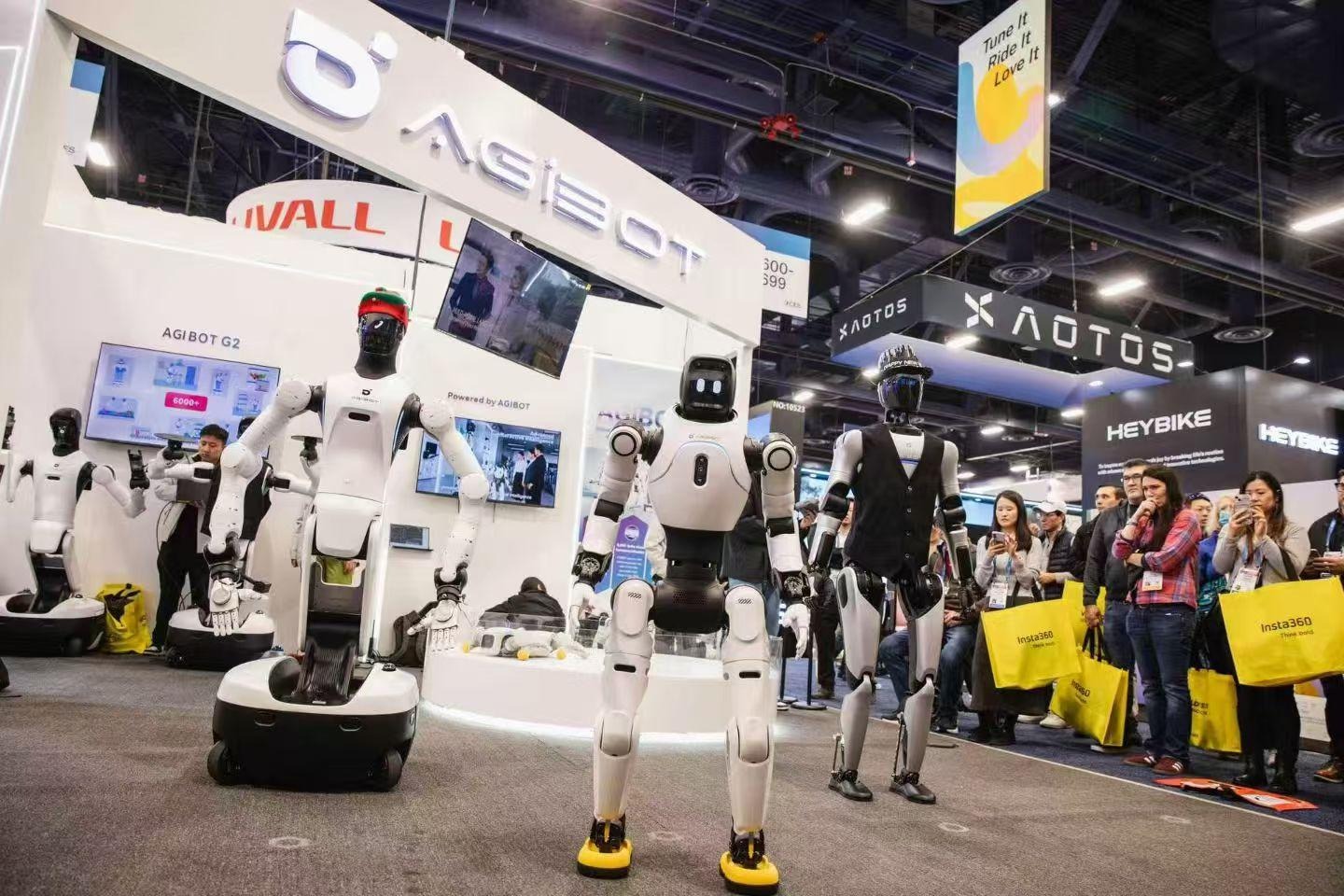
At CES 2026, AGIBOT isn’t just showing off another sci-fi prototype. They’re declaring the start of a new age with a full-scale commercial launch of not one, but an entire lineup of humanoid robots designed for the real world. This isn’t a tentative step, but rather it’s a confident stride into the U.S. market with the full-sized A2 Series and the compact, developer-friendly X2 Series.
The message is clear: the future isn’t a single robot model. It’s the right robot for the right job. And AGIBOT is here to build them all.
Meet the Family: AGIBOT
The A2 Series: Your New (Robotic) Coworker
Think of the A2 as the friendly, capable humanoid you could actually imagine working alongside. At 5’6” and 152 lbs, it’s deliberately built to match human proportions – not to intimidate, but to integrate.
Forget clunky, jerky movements. The A2 boasts up to 40 degrees of freedom, enabling everything from surprisingly smooth dance routines to the fine motor control needed to play an instrument. But the real magic is in the interaction.
This robot can hold a conversation, powered by a multilingual large language model. It doesn’t just respond. It expresses itself. An interactive face screen conveys eleven distinct facial expressions, synced with over a hundred body gestures. It’s a level of social fluency we haven’t seen outside research papers.
The X2 Series: The Tinkerer’s Dream Robot
If the A2 is the polished final product, the X2 is the incredibly powerful building block. At just over 4 feet tall and 79 lbs, this half-sized humanoid is AGIBOT’s nod to developers, researchers, and businesses that need to customize.
This is where things get exciting for the maker community. The X2 is fully modular. AGIBOT is opening it up via APIs, letting you control motion, expressions, audio, lighting, and more. On the hardware side, you can swap components. Imagine replacing its standard hand with AGIBOT’s specialized OmniPicker adaptive gripper for a specific task.
It’s also packed with the same robust sensor suite as its bigger brother (multiple cameras, 3D LiDAR), making it a perfect platform for robotics research and tailored commercial applications.
The G2 Series: The Heavy-Duty Workhorse
Meet the powerhouse of the family. The AGIBOT G2 Series is AGIBOT’s purpose-built solution for heavy operations, designed from the ground up for industrial, commercial, and demanding domestic use cases.
Standing at a formidable two meters tall, the G2 is engineered with automotive-grade components to meet rigorous industrial standards. It’s built to handle a 3 kg single-arm payload, making it capable of real, heavy-lift tasks. Yet, it doesn’t sacrifice finesse for strength. It features 26 degrees of freedom and sub-millimeter accuracy in its hands and fingers. Despite its industrial build, the G2 is surprisingly sensitive. Its arms can detect the lightest touch and actively avoid collisions, while its omnidirectional mobile base allows for fluid rotation and movement in tight spaces. This is not a clumsy machine. It’s a precise tool.
The Secret Sauce: One AI to Rule Them All
What ties this diverse portfolio together isn’t just the AGIBOT logo. It’s a unified vision-language-action AI training system. In simple terms, a skill learned by one robot can be transferred across the entire lineup. This is a game-changer for scalability. A navigation behavior perfected on the G2 Series in a lab can be deployed to a network of robots. This shared intelligence platform is how AGIBOT plans to ensure high reliability while rapidly adapting to new environments, from chaotic factories to quiet hotels.
The Bottom Line: This Isn’t a Demo, It’s a Deployment
AGIBOT arrives at CES with a significant advantage: over 5,000 humanoid robots are already in service across manufacturing, logistics, education, and entertainment in other markets. They’re not a startup promising a future product; they’re an established player launching in a new region.
What does this mean for us? The great humanoid robot experiment is moving from “if” to “where and how.” AGIBOT’s U.S. debut signals that embodied AI is ready to step out of the lab and into our daily lives. It’s not as fragile novelties, but as durable, practical, and surprisingly personable machines.
The glass case is empty. The robots are here.